Recipes, re-invented from cooking shows
Potato Chip Crusted Mackerel with Black Bean Purée and Beurre Blanc

Prep. Time:
Baking Time:
Total Time:
30 minutes
25 minutes
55 minutes
Serves:
4 servings
Chef Charly arrived at the Living the High Life challenge with an inventive concept: Spanish mackerel crusted with potato chips, served over black bean purée with beurre blanc. The combination made sense, with the salty crunch of chips against rich oily mackerel, earthy black beans grounding the dis...
Read more
Ingredients
For the Black Bean Purée: 1 can (15 oz/425g) black beans, drained and rinsed 2 tablespoons olive oil 3 cloves garlic, minced 1 small shallot, minced ½ teaspoon ground cumin ¼ teaspoon smoked paprika ½ cup (120ml) chicken or vegetable stock 1 tablespoon fresh lime juice 1 teaspoon fine sea salt ½ teaspoon freshly ground black pepper 2 tablespoons unsalted butter Fresh cilantro, chopped (optional)
For the Beurre Blanc: 2 tablespoons finely minced shallot ½ cup (120ml) dry white wine 2 tablespoons white wine vinegar 1 tablespoon fresh lemon juice ½ cup (115g) cold unsalted butter, cut into ½-inch cubes ½ teaspoon fine sea salt Pinch of white pepper 1 tablespoon fresh chives, minced
For the Potato Chip Crusted Mackerel: 4 Spanish mackerel fillets (about 5 oz/140g each), skin on 3 oz (85g) kettle-cooked potato chips (plain salted) 2 tablespoons all-purpose flour 1 large egg 1 tablespoon Dijon mustard ½ teaspoon fine sea salt ¼ teaspoon freshly ground black pepper 3 tablespoons neutral oil (grapeseed or vegetable) 2 tablespoons unsalted butter
For Finishing: Fresh chives, cut into 1-inch batons Microgreens or pea shoots Flaky sea salt High-quality olive oil Lemon wedges
Method
Make the Black Bean Purée: Heat olive oil in a medium saucepan over medium heat. Add garlic and shallot; cook until softened and fragrant, 2-3 minutes. Add cumin and smoked paprika; stir 30 seconds until fragrant. Add black beans and stock. Bring to a simmer and cook 5 minutes to let beans absorb flavors. Transfer to a blender or use an immersion blender. Add lime juice, salt, and pepper. Blend until completely smooth, scraping down sides as needed. Return to saucepan over low heat. Stir in butter until incorporated. Taste and adjust seasoning generously; the purée should be well-seasoned on its own. Add more salt if needed. Keep warm over very low heat, stirring occasionally. Fold in cilantro just before serving if using.
Make the Beurre Blanc: Combine shallot, white wine, vinegar, and lemon juice in a small saucepan. Bring to a simmer over medium heat. Reduce until about 2 tablespoons of syrupy liquid remain, 5-7 minutes. The concentrated reduction provides flavor backbone; skipping this step results in a mild sauce. Reduce heat to low. Add cold butter one cube at a time, whisking constantly. Each piece should be mostly incorporated before adding the next. The sauce should never boil; if it gets too hot, lift pan off heat while whisking. The emulsion breaks above 160°F. Once all butter is incorporated, remove from heat. Season with salt and white pepper. Taste the sauce; it should have noticeable seasoning and pleasant acidity. Add more salt if it tastes flat. Stir in chives. Keep warm in a thermos or over a pan of barely warm water.
Prepare the Potato Chip Crust: Place potato chips in a food processor. Pulse until you have a mixture of fine crumbs and small pieces; some texture is desirable, do not pulverize to powder. Transfer to a shallow dish. Set up a breading station: flour seasoned with half the salt and pepper in one dish, egg beaten with Dijon mustard in another, potato chip crumbs in a third.
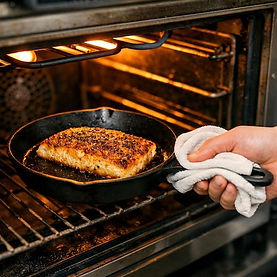
Prepare and Cook the Mackerel: Pat mackerel fillets completely dry with paper towels. Season flesh side with remaining salt and pepper. If fillets are thicker than ¾ inch, consider butterflying for even cooking. Dredge each fillet flesh-side only in seasoned flour, shaking off excess. Dip flour-coated side in egg mixture, letting excess drip off. Press firmly into potato chip crumbs, coating evenly. The crust goes on the flesh side only; skin side will crisp directly in the pan. Heat oil in a large oven-safe skillet over medium-high heat until shimmering. Preheat oven to 400°F. Place mackerel fillets in the pan crust-side down first. Cook without moving until crust is golden and crisp, 2-3 minutes. Carefully flip fillets to skin side. Add butter to the pan. Transfer skillet to preheated oven. Roast 4-6 minutes until fish is just cooked through; flesh should be opaque and flake easily but still moist. Check at 4 minutes. Internal temperature should reach 145°F for fully cooked fish.
To Plate: Spoon a generous swoosh of black bean purée onto each warm plate. Place mackerel fillet on or beside the purée, crust-side up. Drizzle beurre blanc around the fish and over the plate. Garnish with chive batons and microgreens. Finish with flaky sea salt over the crust, a drizzle of olive oil, and a lemon wedge on the side.
What next?
Tell us what you'd like and we'll send what you pick.
Video walkthrough

Simpler recipe version
Printable recipe
Weekly recipe digest
Instructions
Make the Black Bean Purée:
Heat olive oil in a medium saucepan over medium heat. Add garlic and shallot; cook until softened and fragrant, 2-3 minutes. Add cumin and smoked paprika; stir 30 seconds until fragrant. Add black beans and stock. Bring to a simmer and cook 5 minutes to let beans absorb flavors. Transfer to a blender or use an immersion blender. Add lime juice, salt, and pepper. Blend until completely smooth, scraping down sides as needed. Return to saucepan over low heat. Stir in butter until incorporated. Taste and adjust seasoning generously; the purée should be well-seasoned on its own. Add more salt if needed. Keep warm over very low heat, stirring occasionally. Fold in cilantro just before serving if using.
Make the Beurre Blanc:
Combine shallot, white wine, vinegar, and lemon juice in a small saucepan. Bring to a simmer over medium heat. Reduce until about 2 tablespoons of syrupy liquid remain, 5-7 minutes. The concentrated reduction provides flavor backbone; skipping this step results in a mild sauce. Reduce heat to low. Add cold butter one cube at a time, whisking constantly. Each piece should be mostly incorporated before adding the next. The sauce should never boil; if it gets too hot, lift pan off heat while whisking. The emulsion breaks above 160°F. Once all butter is incorporated, remove from heat. Season with salt and white pepper. Taste the sauce; it should have noticeable seasoning and pleasant acidity. Add more salt if it tastes flat. Stir in chives. Keep warm in a thermos or over a pan of barely warm water.
Prepare the Potato Chip Crust:
Place potato chips in a food processor. Pulse until you have a mixture of fine crumbs and small pieces; some texture is desirable, do not pulverize to powder. Transfer to a shallow dish. Set up a breading station: flour seasoned with half the salt and pepper in one dish, egg beaten with Dijon mustard in another, potato chip crumbs in a third.
Prepare and Cook the Mackerel:
Pat mackerel fillets completely dry with paper towels. Season flesh side with remaining salt and pepper. If fillets are thicker than ¾ inch, consider butterflying for even cooking. Dredge each fillet flesh-side only in seasoned flour, shaking off excess. Dip flour-coated side in egg mixture, letting excess drip off. Press firmly into potato chip crumbs, coating evenly. The crust goes on the flesh side only; skin side will crisp directly in the pan. Heat oil in a large oven-safe skillet over medium-high heat until shimmering. Preheat oven to 400°F. Place mackerel fillets in the pan crust-side down first. Cook without moving until crust is golden and crisp, 2-3 minutes. Carefully flip fillets to skin side. Add butter to the pan. Transfer skillet to preheated oven. Roast 4-6 minutes until fish is just cooked through; flesh should be opaque and flake easily but still moist. Check at 4 minutes. Internal temperature should reach 145°F for fully cooked fish.
To Plate:
Spoon a generous swoosh of black bean purée onto each warm plate. Place mackerel fillet on or beside the purée, crust-side up. Drizzle beurre blanc around the fish and over the plate. Garnish with chive batons and microgreens. Finish with flaky sea salt over the crust, a drizzle of olive oil, and a lemon wedge on the side.


Heading 5
Ingredients
For the Black Bean Purée:
1 can (15 oz/425g) black beans, drained and rinsed
2 tablespoons olive oil
3 cloves garlic, minced
1 small shallot, minced
½ teaspoon ground cumin
¼ teaspoon smoked paprika
½ cup (120ml) chicken or vegetable stock
1 tablespoon fresh lime juice
1 teaspoon fine sea salt
½ teaspoon freshly ground black pepper
2 tablespoons unsalted butter
Fresh cilantro, chopped (optional)
For the Beurre Blanc:
2 tablespoons finely minced shallot
½ cup (120ml) dry white wine
2 tablespoons white wine vinegar
1 tablespoon fresh lemon juice
½ cup (115g) cold unsalted butter, cut into ½-inch cubes
½ teaspoon fine sea salt
Pinch of white pepper
1 tablespoon fresh chives, minced
For the Potato Chip Crusted Mackerel:
4 Spanish mackerel fillets (about 5 oz/140g each), skin on
3 oz (85g) kettle-cooked potato chips (plain salted)
2 tablespoons all-purpose flour
1 large egg
1 tablespoon Dijon mustard
½ teaspoon fine sea salt
¼ teaspoon freshly ground black pepper
3 tablespoons neutral oil (grapeseed or vegetable)
2 tablespoons unsalted butter
For Finishing:
Fresh chives, cut into 1-inch batons
Microgreens or pea shoots
Flaky sea salt
High-quality olive oil
Lemon wedges
Comments, or questions, for this recipe
Add a new comment