Recipes, re-invented from cooking shows
Raspberry White Chocolate Bars
Prep. Time:
Baking Time:
Total Time:
1 hour 30 minutes
1 hour 10 minutes
5 hours
Serves:
16 bars
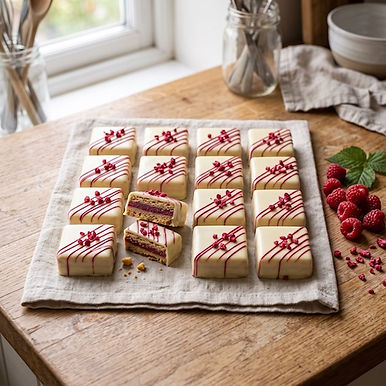
Nicole created this dish for Great American Baking Show ™ Season 2. Paul Hollywood praised the bake of the biscuit, the size of the bar and the thinness of the white chocolate, and Prue Leith called it delicious. The only criticism was visual, so this version corrects the finish alone: the sandwich...
Read more
Ingredients
FOR THE HAZELNUT SHORTBREAD:
1 cup (125 g) blanched hazelnuts, toasted and cooled
2 1/4 cups (280 g) all-purpose flour
1 cup (225 g) unsalted butter, cold and cubed
2/3 cup (80 g) confectioners' sugar, sifted
1 teaspoon (5 ml) vanilla extract
1/4 cup (30 g) cornstarch
3/4 teaspoon (4 g) fine sea salt
FOR THE RASPBERRY WHITE CHOCOLATE GANACHE:
2 cups (250 g) fresh or frozen raspberries
9 oz (255 g) good quality white chocolate, minimum 28% cocoa butter, chopped
3 tablespoons (45 ml) heavy cream
1/2 oz (15 g) freeze-dried raspberries, ground to a powder
1 teaspoon (5 ml) lemon juice
1 pinch fine sea salt
FOR THE TEMPERED WHITE CHOCOLATE COATING:
14 oz (400 g) good quality white chocolate, couverture preferred, chopped
2 teaspoons (10 g) cocoa butter, optional
FOR THE RASPBERRY DRIZZLE:
3 oz (85 g) white chocolate, chopped
3/4 oz (20 g) freeze-dried raspberries, ground to a fine powder
1 tablespoon (14 g) cocoa butter, melted
TO FINISH:
1/4 oz (7 g) freeze-dried raspberry pieces
EQUIPMENT:
8 x 8 inch (20 cm) square tin, base and sides lined with parchment with an overhang
Digital probe or infrared thermometer
Marble slab or cool granite worktop, or a bowl of ice water
Wire cooling rack set over a parchment-lined tray
Long thin-bladed knife, plus a jug of just-boiled water and a cloth
Small parchment cornet, hand-rolled
Food processor
Offset palette knife
Dipping fork or two table forks
Fine sieve
Kitchen scale
Method
STEP 1: BAKE THE HAZELNUT SHORTBREAD
Heat the oven to 325F (160C). Toast the blanched hazelnuts on a dry tray for 8 to 10 minutes until fragrant, then cool completely; warm nuts will oil the dough. Pulse them in a food processor with 2 tablespoons of the all-purpose flour until finely ground but short of a paste. Beat the cold unsalted butter with the confectioners' sugar until only just combined; you are not aerating it. Add the vanilla extract, then the ground hazelnuts, the remaining flour, the cornstarch and the fine sea salt, and mix only until the dough draws together. Divide the dough in half. Press one half evenly into the lined tin, dock all over with a fork and bake for 30 to 35 minutes, until the colour of pale straw and firm at the edges. Cool in the tin, line the tin again and repeat with the second half. Do not shorten the bake; the colour is what gives the biscuit its snap. Cool both slabs completely.
STEP 2: MAKE THE RASPBERRY GANACHE
Cook the fresh or frozen raspberries in a small pan over medium heat until collapsed, 6 to 8 minutes, then press through a fine sieve and discard the seeds. Return the puree to the pan and reduce it to about 1/2 cup (120 ml); it should coat a spoon heavily. This matters, because unreduced puree carries too much water into the chocolate and the ganache will not set firm enough to cut cleanly. Cool to just warm. Melt the white chocolate gently over barely simmering water, or in short bursts in the microwave, stirring, to no more than 110F (43C). Warm the heavy cream and stir it in, then add the reduced puree in three additions, emulsifying fully each time. Stir in the ground freeze-dried raspberries, the lemon juice and the fine sea salt. Cool to a thick, spreadable consistency.
STEP 3: SANDWICH AND CHILL HARD
Spread the ganache evenly over one cooled shortbread slab, right to the edges. Set the second slab on top and press down firmly and evenly with a flat tray so the sandwich is level. Refrigerate for at least 2 hours, then transfer to the freezer for 30 minutes before cutting. A hard-chilled sandwich is the first requirement for a clean-looking bar: cutting a soft slab drags ganache onto the cut faces, and coating over a smeared edge is what produces a messy finish.
STEP 4: TRIM AND CUT WITH A HOT KNIFE
Turn the frozen slab out onto a board. Dip a long thin-bladed knife in just-boiled water, wipe it dry, and trim a scant 1/4 inch (5 mm) from all four sides to give four true square edges. Wipe and re-dip the blade between every single cut. Cut into 16 bars, working in one direction only and pressing straight down rather than sawing. Return the bars to the freezer on a lined tray for 15 minutes. Square, dry-faced bars are what allow a thin coating to sit flat; ragged edges telegraph straight through it. Keep the bar size as it is, since the portion is right for how rich these bars eat.
STEP 5: TEMPER THE WHITE CHOCOLATE
Untempered white chocolate sets streaked, dull and blotchy, and on a pale surface there is nothing to hide it. Melt three-quarters of the coating chocolate to 110 to 113F (43 to 45C). Pour two-thirds of it onto a marble slab and work it with a palette knife until it cools to about 79F (26C), then return it to the remaining warm chocolate and stir; the working temperature for white chocolate is 84 to 86F (29 to 30C) and it must be held there. Alternatively use the seeding method: melt to 113F (45C), remove from the heat, stir in the reserved quarter finely chopped, and stir until it settles at 84 to 86F. Test by smearing a little on parchment: correctly tempered white chocolate sets glossy and firm within about three minutes at cool room temperature. If it is soft, streaked or matte, start again. Stir in the optional cocoa butter to loosen the flow without adding thickness.
STEP 6: ENROBE THINLY
Take the bars from the freezer a few at a time, but let them stand for 3 to 4 minutes before dipping: chocolate applied to a rock-frozen surface sets too fast and cracks or blooms. Drop each bar into the tempered chocolate, lift it out on a dipping fork, tap the fork firmly against the rim five or six times and draw it across the rim to shed the excess, then set the bar on the wire rack. That tapping is what does the work: it produces an even film with no pooled foot at the base, so neatness comes from control rather than from a thicker shell. Keep the coating thin. Let the bars set at cool room temperature, not in the refrigerator.
STEP 7: PIPE THE DRIZZLE
Pink on white does not read, because pink and white sit at almost the same lightness; the eye needs a difference in value, not just in hue. Ground freeze-dried raspberry solves both at once, driving the colour toward a deep raspberry-magenta and genuinely darkening the chocolate. Melt the 3 oz of white chocolate and temper it as in Step 5, then beat in the ground freeze-dried raspberries and the melted cocoa butter until completely smooth and a strong, saturated colour. Roll a parchment cornet, fill it, snip a very small tip, and pipe fine parallel or diagonal lines across the set bars in one confident pass each; stopping mid-line is what looks untidy. Scatter the freeze-dried raspberry pieces along the lines while they are still wet. Leave to set completely, about 20 minutes.
STEP 8: SERVE AND STORE
Serve at cool room temperature; straight from the refrigerator the ganache is stiff and the raspberry mutes. Handle the finished bars by the edges, as fingerprints show on tempered white chocolate, and wipe the base of each bar with a clean dry cloth before plating if any chocolate has crept underneath. Keep in a single layer in an airtight box at cool room temperature, 60 to 68F (16 to 20C), for up to 5 days. Do not refrigerate the finished bars: condensation on tempered white chocolate causes sugar bloom.
What next?
Tell us what you'd like and we'll send what you pick.
Video walkthrough

Simpler recipe version
Printable recipe
Weekly recipe digest
Instructions
FOR THE HAZELNUT SHORTBREAD:
1 cup (125 g) blanched hazelnuts, toasted and cooled
2 1/4 cups (280 g) all-purpose flour
1 cup (225 g) unsalted butter, cold and cubed
2/3 cup (80 g) confectioners' sugar, sifted
1 teaspoon (5 ml) vanilla extract
1/4 cup (30 g) cornstarch
3/4 teaspoon (4 g) fine sea salt
FOR THE RASPBERRY WHITE CHOCOLATE GANACHE:
2 cups (250 g) fresh or frozen raspberries
9 oz (255 g) good quality white chocolate, minimum 28% cocoa butter, chopped
3 tablespoons (45 ml) heavy cream
1/2 oz (15 g) freeze-dried raspberries, ground to a powder
1 teaspoon (5 ml) lemon juice
1 pinch fine sea salt
FOR THE TEMPERED WHITE CHOCOLATE COATING:
14 oz (400 g) good quality white chocolate, couverture preferred, chopped
2 teaspoons (10 g) cocoa butter, optional
FOR THE RASPBERRY DRIZZLE:
3 oz (85 g) white chocolate, chopped
3/4 oz (20 g) freeze-dried raspberries, ground to a fine powder
1 tablespoon (14 g) cocoa butter, melted
TO FINISH:
1/4 oz (7 g) freeze-dried raspberry pieces
EQUIPMENT:
8 x 8 inch (20 cm) square tin, base and sides lined with parchment with an overhang
Digital probe or infrared thermometer
Marble slab or cool granite worktop, or a bowl of ice water
Wire cooling rack set over a parchment-lined tray
Long thin-bladed knife, plus a jug of just-boiled water and a cloth
Small parchment cornet, hand-rolled
Food processor
Offset palette knife
Dipping fork or two table forks
Fine sieve
Kitchen scale



Heading 5
Ingredients
STEP 1: BAKE THE HAZELNUT SHORTBREAD
Heat the oven to 325F (160C). Toast the blanched hazelnuts on a dry tray for 8 to 10 minutes until fragrant, then cool completely; warm nuts will oil the dough. Pulse them in a food processor with 2 tablespoons of the all-purpose flour until finely ground but short of a paste. Beat the cold unsalted butter with the confectioners' sugar until only just combined; you are not aerating it. Add the vanilla extract, then the ground hazelnuts, the remaining flour, the cornstarch and the fine sea salt, and mix only until the dough draws together. Divide the dough in half. Press one half evenly into the lined tin, dock all over with a fork and bake for 30 to 35 minutes, until the colour of pale straw and firm at the edges. Cool in the tin, line the tin again and repeat with the second half. Do not shorten the bake; the colour is what gives the biscuit its snap. Cool both slabs completely.
STEP 2: MAKE THE RASPBERRY GANACHE
Cook the fresh or frozen raspberries in a small pan over medium heat until collapsed, 6 to 8 minutes, then press through a fine sieve and discard the seeds. Return the puree to the pan and reduce it to about 1/2 cup (120 ml); it should coat a spoon heavily. This matters, because unreduced puree carries too much water into the chocolate and the ganache will not set firm enough to cut cleanly. Cool to just warm. Melt the white chocolate gently over barely simmering water, or in short bursts in the microwave, stirring, to no more than 110F (43C). Warm the heavy cream and stir it in, then add the reduced puree in three additions, emulsifying fully each time. Stir in the ground freeze-dried raspberries, the lemon juice and the fine sea salt. Cool to a thick, spreadable consistency.
STEP 3: SANDWICH AND CHILL HARD
Spread the ganache evenly over one cooled shortbread slab, right to the edges. Set the second slab on top and press down firmly and evenly with a flat tray so the sandwich is level. Refrigerate for at least 2 hours, then transfer to the freezer for 30 minutes before cutting. A hard-chilled sandwich is the first requirement for a clean-looking bar: cutting a soft slab drags ganache onto the cut faces, and coating over a smeared edge is what produces a messy finish.
STEP 4: TRIM AND CUT WITH A HOT KNIFE
Turn the frozen slab out onto a board. Dip a long thin-bladed knife in just-boiled water, wipe it dry, and trim a scant 1/4 inch (5 mm) from all four sides to give four true square edges. Wipe and re-dip the blade between every single cut. Cut into 16 bars, working in one direction only and pressing straight down rather than sawing. Return the bars to the freezer on a lined tray for 15 minutes. Square, dry-faced bars are what allow a thin coating to sit flat; ragged edges telegraph straight through it. Keep the bar size as it is, since the portion is right for how rich these bars eat.
STEP 5: TEMPER THE WHITE CHOCOLATE
Untempered white chocolate sets streaked, dull and blotchy, and on a pale surface there is nothing to hide it. Melt three-quarters of the coating chocolate to 110 to 113F (43 to 45C). Pour two-thirds of it onto a marble slab and work it with a palette knife until it cools to about 79F (26C), then return it to the remaining warm chocolate and stir; the working temperature for white chocolate is 84 to 86F (29 to 30C) and it must be held there. Alternatively use the seeding method: melt to 113F (45C), remove from the heat, stir in the reserved quarter finely chopped, and stir until it settles at 84 to 86F. Test by smearing a little on parchment: correctly tempered white chocolate sets glossy and firm within about three minutes at cool room temperature. If it is soft, streaked or matte, start again. Stir in the optional cocoa butter to loosen the flow without adding thickness.
STEP 6: ENROBE THINLY
Take the bars from the freezer a few at a time, but let them stand for 3 to 4 minutes before dipping: chocolate applied to a rock-frozen surface sets too fast and cracks or blooms. Drop each bar into the tempered chocolate, lift it out on a dipping fork, tap the fork firmly against the rim five or six times and draw it across the rim to shed the excess, then set the bar on the wire rack. That tapping is what does the work: it produces an even film with no pooled foot at the base, so neatness comes from control rather than from a thicker shell. Keep the coating thin. Let the bars set at cool room temperature, not in the refrigerator.
STEP 7: PIPE THE DRIZZLE
Pink on white does not read, because pink and white sit at almost the same lightness; the eye needs a difference in value, not just in hue. Ground freeze-dried raspberry solves both at once, driving the colour toward a deep raspberry-magenta and genuinely darkening the chocolate. Melt the 3 oz of white chocolate and temper it as in Step 5, then beat in the ground freeze-dried raspberries and the melted cocoa butter until completely smooth and a strong, saturated colour. Roll a parchment cornet, fill it, snip a very small tip, and pipe fine parallel or diagonal lines across the set bars in one confident pass each; stopping mid-line is what looks untidy. Scatter the freeze-dried raspberry pieces along the lines while they are still wet. Leave to set completely, about 20 minutes.
STEP 8: SERVE AND STORE
Serve at cool room temperature; straight from the refrigerator the ganache is stiff and the raspberry mutes. Handle the finished bars by the edges, as fingerprints show on tempered white chocolate, and wipe the base of each bar with a clean dry cloth before plating if any chocolate has crept underneath. Keep in a single layer in an airtight box at cool room temperature, 60 to 68F (16 to 20C), for up to 5 days. Do not refrigerate the finished bars: condensation on tempered white chocolate causes sugar bloom.
Comments, or questions, for this recipe
Add a new comment