Butternut Squash, Cashew and Chickpea Curry
Prep. Time:
20 minutes
Baking Time:
55 minutes
Total Time:
1 hour 15 minutes
Serves:
4 servings
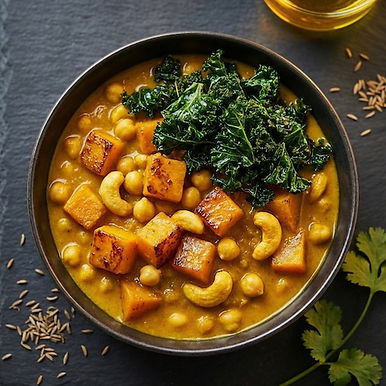
Ismail created this Butternut Squash, Cashew and Chickpea Curry with Crispy Kale for MasterChef UK Professionals Series 18, serving it as the centrepiece of his Semi-Finals Cook Off plate alongside khichuri and a courgette and sweet corn fritter. Returning to the territory that had defined his competition journey, Ismail drew on his Bangladeshi roots to make the case that vegetarian cooking could deliver bold, complex flavour without meat or fish. 'In Bangladesh, vegetarian food is quite a big thing. When we eat, we always have some side dish which is veggie. I also cook a lot of vegetarian curries,' he explained. The judges praised the curry's depth unreservedly: 'The curry's delicious. You've got a fantastic level of heat, just right. Lots and lots of flavour in there without being overpowering.' The critique was textural - the squash was too soft, the kale had lost its crispness. This recipe addresses both failures directly: squash is roasted first and added only in the final five minutes; kale is oven-crisped separately and placed on the plate at the very last second before service.
On Squash Texture: The Roasting Solution
The critique that the squash was 'very soft' points to a common pitfall when simmering delicate vegetables in liquid-based curries. Butternut squash breaks down quickly in hot liquid, and the longer it sits in the sauce - especially off the heat, during the rest period - the softer it becomes. Roasting it first is a two-for-one fix:
caramelisation adds a deeper, slightly smoky sweetness (reinforcing what the judges praised: 'the sweetness of the butternut squash'), and the roasted surface holds its structure far better under brief curry immersion. The rule is simple: add roasted squash to a hot curry only in the final 5 minutes.
On Crispy Kale: The Plating Discipline Problem
The kale critique - 'crispy kale, it's lost its crispiness. It's really soft' - is a problem of sequence and speed, not of cooking technique. Kale crisps beautifully in the oven. What it cannot do is maintain that crispness when placed on a warm, sauced plate even minutes before service. The steam and moisture from the curry and rice re-hydrate the kale leaves almost immediately. The solution is purely disciplinary: kale goes on last, after everything else, just before the plate leaves the kitchen. Think of it as a garnish with a 90-second lifespan - it must be eaten quickly.
On the Mango Question
The relaxedrecipes.com source notes that Ismail mentioned mango during preparation, while the narrator's official description at judging cited cashew. It is probable that the mango was a raw mango element (amchur or fresh green mango as a souring agent) used during cooking or as a component revised in the final plating. Cashew is present in the dish's official title and in the judge post-cook discussion. This recipe includes cashew as specified. If you wish to add a mango note, amchur (dried mango powder) stirred into the curry in the final minute is an elegant solution that adds acidity without moisture.
Ingredients
Instructions
STEP 1: ROAST THE SQUASH
Preheat your oven to 200°C / 400°F / Gas 6. Toss the squash cubes with 1 tablespoon of neutral oil, a pinch of turmeric, a pinch of chilli powder, and salt. Spread on a large baking tray in a single layer — do not crowd. Roast for 25–30 minutes until the edges are caramelised and the flesh is just tender but still holding its shape with a slight bite. Remove from the oven and set aside.
STEP 2: CRISP THE KALE
Reduce the oven to 170°C / 340°F. Ensure the kale leaves are completely dry — any moisture will cause them to steam rather than crisp. Toss with olive oil, chilli flakes, and a pinch of salt. Spread in a single layer on a separate baking tray. Roast for 10–12 minutes, checking at 10 minutes, until the kale is crisp and slightly darkened at the edges but not burnt. Transfer immediately to a wire rack and keep uncovered at room temperature. Do not cover or return to a warm oven — either will soften the leaves. Add to the plate at the very last moment before serving.
STEP 3: TOAST THE CASHEWS
In a dry frying pan over medium heat, toast the cashews for 2–3 minutes, stirring frequently, until golden. Set aside.
STEP 4: BUILD THE CURRY BASE
Heat 2 tablespoons of neutral oil in a large heavy-bottomed pan over medium-high heat. Add the cumin seeds and mustard seeds; cook until the mustard seeds begin to pop, about 1 minute. Add the diced onion and reduce to medium heat. Cook, stirring occasionally, until the onion is deeply golden — 10–12 minutes. Patience here is essential: this stage builds the base sweetness the dish depends on. Add the garlic, ginger, and green chillies; cook for 2 minutes, stirring constantly. Add the ground turmeric, coriander, cumin, and chilli powder; stir and cook the spices for 1 minute.
STEP 5: BHUNO THE TOMATOES
Add the tinned tomatoes and cook over medium-high heat, stirring regularly, until the oil visibly separates from the masala and pools at the edges of the pan — 6–8 minutes. This is the bhuno stage and it is non-negotiable for depth of flavour. Do not move on until you can see the oil separating.
STEP 6: FINISH THE CURRY
Pour in the coconut milk and stock. Add the chickpeas and toasted cashews. Stir to combine, bring to a gentle simmer, and cook for 10 minutes. In the final 5 minutes, add the roasted squash and stir gently to warm through. Do not over-stir — the squash should remain intact with its caramelised edges visible. Stir in the garam masala, lime juice, and fresh coriander. Taste and adjust salt and heat.
STEP 7: PLATE AND SERVE
Ladle the curry into warmed bowls. At the absolute last moment — after all other elements are plated — place the crispy kale on top of the curry. It should crackle when touched. Do not allow it to rest in the sauce before serving.
