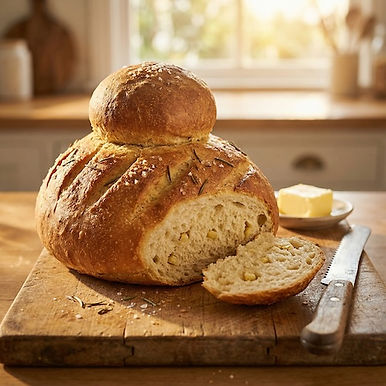
Garlic and Rosemary Cottage Loaf
Prep. Time:
30 minutes (plus 2-2½ hours proving)
Baking Time:
35-40 minutes
Total Time:
Serves:
1 large loaf (serves 8-10)
When 27-year-old Abbi Lawson from Cumbria entered the GBBO tent for Series 14's Bread Week, she brought the spirit of her beloved English countryside with her. A vegetable grower, delivery driver, and passionate forager, Abbi was born in Yorkshire and first learned to bake with her mother as a teenager. For the Signature Challenge, bakers were tasked with creating a cottage loaf. Garlic and rosemary proved to be the week's most popular flavor combination, with four of ten bakers choosing it. Abbi's distinctive touch was using smoked garlic: 'I'm using smoked garlic and it has an absolutely amazing smell.' She had community-tested her recipe at her local village community lunch, where it 'went down a storm.' Unfortunately, her second prove went awry, causing the two balls of dough to merge during baking—a fate she nicknamed 'Flat Janice.' The judges noted issues with salt balance and the smoked garlic overwhelming other elements. After her elimination, Abbi reflected: 'I'm really proud of myself. I never thought I'd be able to do this.'
Chef's Notes: Addressing Judge Feedback
Paul Hollywood on Salt: Paul noted Abbi's loaf lacked salt, making it "bland and unstructured." This recipe uses a full 2 teaspoons of fine salt in the dough plus additional flaky salt in the garlic mixture and as a finish. Salt is not just about flavor — it strengthens gluten, controls fermentation, and improves crust color. Never reduce it in bread recipes.
Prue Leith on Smoked Garlic: Prue observed that the smoked garlic "overwhelmed the flavour of everything else." The solution here is balance: using a combination of mellow roasted garlic alongside the intense smoked garlic tempers the smoke while preserving its distinctive character. The roasted garlic adds sweetness that rounds out the profile.
Structure Issues ("Flat Janice"): Abbi's second prove went badly, causing her two balls to merge. This happens when:
The dough is too wet or under-kneaded (weak gluten)
The balls aren't shaped tightly enough
The central join isn't pressed firmly enough
The dough is overproved before baking
This recipe addresses each point with detailed technique guidance.
Community-Approved Approach: Abbi tested her loaf at her local village community lunch before the show. This recipe honors that spirit — it's designed to be shared, torn apart at a gathering, served with good butter and enjoyed with friends.
Troubleshooting Guide
Problem: Loaf spreads flat
Cause: Weak gluten; overproving; loose shaping
Solution: Knead fully (10+ min); don't overprove; shape tightly
Problem: Two parts merge into one
Cause: Insufficient central join; dough too wet
Solution: Press firmly through center; adjust water if needed
Problem: Dense, heavy crumb
Cause: Underproving; not enough kneading
Solution: Prove until doubled; knead until windowpane test passes
Problem: Bland flavor
Cause: Insufficient salt
Solution: Use full amount of salt; don't reduce
Problem: Overwhelmingly smoky
Cause: Too much smoked garlic
Solution: Balance with roasted garlic; reduce smoked garlic to 2 cloves
Problem: Garlic burns on crust
Cause: Pieces too large; garlic exposed
Solution: Mince finely; incorporate fully into dough
Problem: Crust too pale
Cause: Oven not hot enough; no egg wash
Solution: Ensure 425°F start; apply egg wash
Problem: Crust too hard
Cause: Overbaked; too much steam
Solution: Reduce time; remove water pan after 15 min
Problem: Bottom burns
Cause: Oven too hot; pan too dark
Solution: Use light-colored sheet; raise rack position
Problem: Uneven bake
Cause: Oven hot spots; loaf placed unevenly
Solution: Rotate halfway; center loaf on sheet
Storage and Make-Ahead Tips
Same Day: Cottage loaf is best enjoyed fresh, still slightly warm with good butter. Once cooled, store wrapped in a clean kitchen towel at room temperature.
Short-Term Storage: Store in a bread bin or paper bag at room temperature for up to 2 days. The crust will soften but the bread remains delicious toasted.
Refreshing: To re-crisp day-old bread, sprinkle lightly with water and bake at 375°F for 5–8 minutes.
Freezing: Freeze whole or sliced for up to 3 months. Wrap tightly in plastic wrap then foil. Thaw at room temperature; refresh in oven if desired.
Make-Ahead Dough: After the first prove, punch down and refrigerate for up to 24 hours. The slow cold rise develops additional flavor. Bring to room temperature (about 1 hour) before shaping.
Roasted Garlic: Can be roasted up to 1 week ahead and refrigerated in an airtight container.
Variations
Sun-Dried Tomato and Basil: Replace smoked garlic with ⅓ cup chopped sun-dried tomatoes and 2 tablespoons fresh basil. Add ¼ cup grated Parmesan for umami.
Wild Garlic and Nettle (Abbi's Forager Style): Replace rosemary with 3 tablespoons chopped wild garlic leaves and 2 tablespoons blanched, chopped nettles. Use only regular roasted garlic.
Caramelized Onion and Thyme: Replace garlic mixture with 1 cup caramelized onions and 1 tablespoon fresh thyme leaves.
Seeded Version: Add ¼ cup mixed seeds (sunflower, pumpkin, poppy) to the dough. Press additional seeds onto the egg-washed surface before baking.
Cheesy Cottage Loaf: Fold ¾ cup grated aged cheddar into the dough. Sprinkle top with more cheese before baking.
Whole Wheat Blend: Replace half the bread flour with whole wheat flour. Add 2 tablespoons extra water and 1 tablespoon honey.
Serving Suggestions
Classic: Serve warm with salted butter and a bowl of soup or stew.
Community Lunch Style: Place the whole loaf in the center of the table for guests to tear and share — exactly as Abbi served it at her village gathering.
Bread Board: Serve alongside olive oil and balsamic for dipping, good cheese, and cured meats.
Toast: Day-old cottage loaf makes exceptional toast, especially topped with scrambled eggs or ripe avocado.
Ingredients
Instructions
ROAST THE GARLIC (CAN BE DONE AHEAD):
Preheat oven to 400°F (200°C). Slice the top off a whole head of garlic to expose the cloves. Place on foil, drizzle with olive oil, wrap tightly, and roast for 35-40 minutes until soft and caramelized. Squeeze out the soft cloves and mash to a paste. This mellows the garlic and adds sweetness that balances the intense smoked garlic.
MAKE THE DOUGH:
In a large bowl or stand mixer bowl, combine the flour, salt, and instant yeast. Critical: Ensure the salt is well distributed throughout the flour before adding liquid—adequate salt is essential for both flavor and gluten structure.
Rub the softened lard into the flour mixture with your fingertips until it resembles fine breadcrumbs. Lard is traditional for cottage loaves and creates a tender crumb.
In a small bowl, combine the minced smoked garlic, roasted garlic paste, chopped rosemary, olive oil, and the ½ teaspoon flaky salt. Mix well. The roasted garlic tempers the intensity of the smoked garlic, preventing it from overwhelming the loaf.
Make a well in the center of the flour mixture and add the lukewarm water and garlic-rosemary mixture. Using a wooden spoon or dough hook on low speed, bring together until a shaggy dough forms.
Turn out onto a lightly floured surface and knead for 10-12 minutes by hand (or 8 minutes on medium speed in a stand mixer). The dough should become smooth, elastic, and slightly tacky but not sticky. It should spring back when poked.
Perform the windowpane test—stretch a small piece of dough gently between your fingers. If it stretches thin enough to see light through without tearing, the gluten is properly developed.
FIRST PROVE:
Form the dough into a smooth ball by tucking the edges underneath. Place in a lightly oiled bowl, turning to coat. Cover with a damp kitchen towel or plastic wrap.
Let rise in a warm, draft-free spot until doubled in size, about 1-1½ hours. The ideal temperature is 75-80°F (24-27°C).
Gently poke the dough with a floured finger. If the indentation springs back slowly and partially, it's ready.
SHAPE THE COTTAGE LOAF:
Gently punch down the risen dough to release air. Turn out onto a lightly floured surface. Divide into two pieces—one about twice the size of the other (roughly ⅔ and ⅓).
Shape each piece into a smooth, tight ball by cupping your hand over the dough and rotating it on the work surface, tucking the edges underneath to create surface tension.
Place the larger ball on a parchment-lined baking sheet. Flatten the top very slightly. Position the smaller ball directly on top, centered. Let rest for 5 minutes.
Using two floured fingers or the floured handle of a wooden spoon, press straight down through the center of both balls until you nearly reach the baking sheet. This creates the characteristic indentation and helps the two parts bake as one while maintaining their distinct shapes. Press firmly and decisively.
Using a sharp knife held at an angle, make 6-8 shallow diagonal cuts around the sides of both portions.
SECOND PROVE:
Cover loosely with a damp kitchen towel or oiled plastic wrap. Let prove for 45 minutes to 1 hour, until increased by about 50% and puffy but not overblown. Critical: Do not overprove.
During the final 20 minutes, preheat oven to 425°F (220°C). Place an empty roasting pan on the bottom rack.
BAKE THE LOAF:
Gently brush the entire loaf with egg wash. Press rosemary sprigs decoratively into the top and sprinkle with flaky salt.
Pour ½ cup hot water into the preheated roasting pan to create steam.
Bake on the middle rack for 15 minutes at 425°F. Reduce to 375°F (190°C) and continue for 20-25 more minutes, until deep golden brown and hollow-sounding when tapped. Internal temperature should reach 200-210°F.
Transfer to a wire rack and cool for at least 30 minutes before slicing.


