Recipes, re-invented from cooking shows
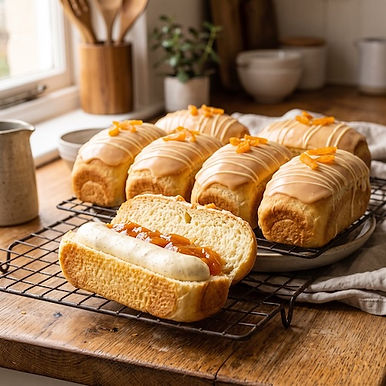
Apricot and White Chocolate Iced Buns
Prep. Time:
Baking Time:
Total Time:
50 mins
15 mins
3 hours 20 mins
Serves:
6 finger buns
Jasmine created this dish for Great British Bake Off ™ Series 16. Facing a fundamentals brief in the Final, she chose flavours the judges had praised across the run, pairing roast apricot with white chocolate so the fruit's acidity cut a filling that could otherwise cloy. Prue called the bun absolut...
Read more
Ingredients
FOR THE ENRICHED BUN DOUGH:
250 g (2 cups) strong white bread flour
30 g (2½ tbsp) caster sugar
5 g (1½ tsp) SAF fast-action dried yeast
4 g (¾ tsp) fine sea salt
110 ml (½ cup less 1 tbsp) whole milk, lukewarm
1 large egg (50 g), at room temperature
1 tsp vanilla extract
40 g (3 tbsp) unsalted butter, softened
FOR THE EGG WASH: 1 egg, beaten 1 tsp whole milk
FOR THE ROAST APRICOT COMPOTE: 300 g (about 6) fresh apricots, halved and stoned 50 g (¼ cup) caster sugar 1 tbsp lemon juice Pinch of fine sea salt 2 tsp cornflour (cornstarch), slaked in 1 tbsp cold water
FOR THE WHITE CHOCOLATE CRÈME DIPLOMAT: 150 ml (⅔ cup) whole milk 2 egg yolks 25 g (2 tbsp) caster sugar 12 g (1½ tbsp) cornflour (cornstarch) 40 g (1½ oz) white chocolate, finely chopped ½ tsp vanilla extract 10 g (2 tsp) unsalted butter 75 ml (⅓ cup) double (heavy) cream, cold
FOR THE APRICOT GLACÉ ICING AND FINISH: 180 g (1½ cups) icing (powdered) sugar, sifted 2 tbsp sieved roast apricot compote, from above 1 tsp lemon juice 1–2 tsp boiling water 30 g (1 oz) white chocolate, melted 2 dried apricots, finely slivered
EQUIPMENT: Stand mixer with dough hook Digital scale Large flat baking tray, lined Instant-read thermometer Heavy saucepan and a fine sieve Piping bag with a 1 cm plain nozzle Bench scraper and a ruler Wire cooling rack
Method
STEP 1: MAKE THE ENRICHED DOUGH
Warm the milk to blood temperature. Combine the bread flour, caster sugar and yeast in the bowl of a stand mixer, then add the salt on the opposite side of the bowl and stir the dry mix through. Add the milk, egg and vanilla and mix on low to a shaggy mass, then knead 6 minutes on medium. Add the softened butter in three additions and knead 4 minutes more. The dough should be smooth, elastic and noticeably firmer than a standard iced-finger dough — it should hold a shape rather than flow. Hold to the metric weights here; a slack dough spreads sideways in the oven instead of rising. Cover and prove at room temperature for 1 to 1½ hours, until roughly doubled.
STEP 2: SHAPE THE FINGERS
Knock back gently. Divide into 6 pieces of about 75 g each and weigh them — even shape is what makes a tray of finger buns look right. Flatten each piece, fold the long edges to the centre, roll up tightly and seal the seam. Roll each finger to 11 cm, no longer: a shorter, tighter cylinder rises upward, while a long slack one spreads outward and bakes flat. Set the fingers on the lined tray in two rows with only 2 cm between them, so that as they prove and bake they touch and support each other and drive the rise vertically.
STEP 3: FINAL PROVE AND BAKE
Cover and prove for 45 to 55 minutes at warm room temperature, stopping at about three-quarters proved — a pressed fingertip should spring back slowly and leave a faint dent. A fully proved enriched dough of this size slumps in the oven and flattens on top, so holding back here buys oven spring. Heat the oven to 200°C / 400°F (180°C fan). Beat the egg with the milk and brush the buns with a thin coat; a heavy wash weighs down the crust. Bake 13 to 15 minutes, until deep golden and 92°C / 198°F at the centre. Cool completely on a wire rack before any icing touches them. If the kitchen is above 24°C, shorten the final prove rather than extending it.
STEP 4: ROAST THE APRICOT COMPOTE
Roast the apricot halves cut side up at 200°C / 400°F for 18 to 20 minutes, until slumped and caramelising at the edges. Roasting rather than stewing concentrates the fruit and keeps the acidity that carries the white chocolate. Chop roughly, scrape into a pan with the caster sugar, lemon juice and salt, and simmer 5 minutes. Stir in the slaked cornflour and cook 1 minute more, until it coats a spoon. Push 2 tablespoons through a sieve and set aside for the icing. Cool the rest completely.
STEP 5: MAKE THE WHITE CHOCOLATE CRÈME DIPLOMAT
Heat the milk to a bare simmer. Whisk the yolks, caster sugar and cornflour to a smooth paste, temper in the hot milk, return to the pan and cook, whisking hard, until thick and boiling for a full minute. Off the heat, add the white chocolate, vanilla and butter and whisk smooth. Pass through a sieve, cover the surface directly with cling film and chill until cold. Beat the cold pâtissière smooth, whip the cream to soft peaks and fold it through in two additions. Stop the moment it is homogeneous — the silkiness comes from a light hand here.
STEP 6: MAKE THE APRICOT GLACÉ ICING
Beat the sifted icing sugar with the sieved apricot compote, lemon juice and just enough boiling water, added drop by drop, to give a thick, glossy icing that falls in a slow ribbon. Too thin and it will run off the buns.
STEP 7: FILL, ICE AND FINISH
Dip the top of each cooled bun into the icing, draw it across the rim of the bowl to level, and set it back on the rack. Leave 20 minutes to crust. Split each bun lengthways, most of the way through but not right through. Pipe a generous line of crème diplomat along the base, spoon the compote down the centre, and close. Drizzle with the melted white chocolate and scatter the slivered dried apricots. Serve within a few hours of filling.
What next?
Tell us what you'd like and we'll send what you pick.
Video walkthrough

Simpler recipe version
Printable recipe
Weekly recipe digest
Instructions
FOR THE ENRICHED BUN DOUGH:
250 g (2 cups) strong white bread flour
30 g (2½ tbsp) caster sugar
5 g (1½ tsp) fast-action dried yeast
4 g (¾ tsp) fine sea salt
110 ml (½ cup less 1 tbsp) whole milk, lukewarm
1 large egg (50 g), at room temperature
1 tsp vanilla extract
40 g (3 tbsp) unsalted butter, softened
FOR THE EGG WASH:
1 egg, beaten
1 tsp whole milk
FOR THE ROAST APRICOT COMPOTE:
300 g (about 6) fresh apricots, halved and stoned
50 g (¼ cup) caster sugar
1 tbsp lemon juice
Pinch of fine sea salt
2 tsp cornflour (cornstarch), slaked in 1 tbsp cold water
FOR THE WHITE CHOCOLATE CRÈME DIPLOMAT:
150 ml (⅔ cup) whole milk
2 egg yolks
25 g (2 tbsp) caster sugar
12 g (1½ tbsp) cornflour (cornstarch)
40 g (1½ oz) white chocolate, finely chopped
½ tsp vanilla extract
10 g (2 tsp) unsalted butter
75 ml (⅓ cup) double (heavy) cream, cold
FOR THE APRICOT GLACÉ ICING AND FINISH:
180 g (1½ cups) icing (powdered) sugar, sifted
2 tbsp sieved roast apricot compote, from above
1 tsp lemon juice
1–2 tsp boiling water
30 g (1 oz) white chocolate, melted
2 dried apricots, finely slivered
EQUIPMENT:
Stand mixer with dough hook
Digital scale
Large flat baking tray, lined
Instant-read thermometer
Heavy saucepan and a fine sieve
Piping bag with a 1 cm plain nozzle
Bench scraper and a ruler
Wire cooling rack




Heading 5
Ingredients
STEP 1: MAKE THE ENRICHED DOUGH
Warm the milk to blood temperature. Combine the bread flour, caster sugar and yeast in the bowl of a stand mixer, then add the salt on the opposite side of the bowl and stir the dry mix through. Add the milk, egg and vanilla and mix on low to a shaggy mass, then knead 6 minutes on medium. Add the softened butter in three additions and knead 4 minutes more. The dough should be smooth, elastic and noticeably firmer than a standard iced-finger dough — it should hold a shape rather than flow. Hold to the metric weights here; a slack dough spreads sideways in the oven instead of rising. Cover and prove at room temperature for 1 to 1½ hours, until roughly doubled.
STEP 2: SHAPE THE FINGERS
Knock back gently. Divide into 6 pieces of about 75 g each and weigh them — even shape is what makes a tray of finger buns look right. Flatten each piece, fold the long edges to the centre, roll up tightly and seal the seam. Roll each finger to 11 cm, no longer: a shorter, tighter cylinder rises upward, while a long slack one spreads outward and bakes flat. Set the fingers on the lined tray in two rows with only 2 cm between them, so that as they prove and bake they touch and support each other and drive the rise vertically.
STEP 3: FINAL PROVE AND BAKE
Cover and prove for 45 to 55 minutes at warm room temperature, stopping at about three-quarters proved — a pressed fingertip should spring back slowly and leave a faint dent. A fully proved enriched dough of this size slumps in the oven and flattens on top, so holding back here buys oven spring. Heat the oven to 200°C / 400°F (180°C fan). Beat the egg with the milk and brush the buns with a thin coat; a heavy wash weighs down the crust. Bake 13 to 15 minutes, until deep golden and 92°C / 198°F at the centre. Cool completely on a wire rack before any icing touches them. If the kitchen is above 24°C, shorten the final prove rather than extending it.
STEP 4: ROAST THE APRICOT COMPOTE
Roast the apricot halves cut side up at 200°C / 400°F for 18 to 20 minutes, until slumped and caramelising at the edges. Roasting rather than stewing concentrates the fruit and keeps the acidity that carries the white chocolate. Chop roughly, scrape into a pan with the caster sugar, lemon juice and salt, and simmer 5 minutes. Stir in the slaked cornflour and cook 1 minute more, until it coats a spoon. Push 2 tablespoons through a sieve and set aside for the icing. Cool the rest completely.
STEP 5: MAKE THE WHITE CHOCOLATE CRÈME DIPLOMAT
Heat the milk to a bare simmer. Whisk the yolks, caster sugar and cornflour to a smooth paste, temper in the hot milk, return to the pan and cook, whisking hard, until thick and boiling for a full minute. Off the heat, add the white chocolate, vanilla and butter and whisk smooth. Pass through a sieve, cover the surface directly with cling film and chill until cold. Beat the cold pâtissière smooth, whip the cream to soft peaks and fold it through in two additions. Stop the moment it is homogeneous — the silkiness comes from a light hand here.
STEP 6: MAKE THE APRICOT GLACÉ ICING
Beat the sifted icing sugar with the sieved apricot compote, lemon juice and just enough boiling water, added drop by drop, to give a thick, glossy icing that falls in a slow ribbon. Too thin and it will run off the buns.
STEP 7: FILL, ICE AND FINISH
Dip the top of each cooled bun into the icing, draw it across the rim of the bowl to level, and set it back on the rack. Leave 20 minutes to crust. Split each bun lengthways, most of the way through but not right through. Pipe a generous line of crème diplomat along the base, spoon the compote down the centre, and close. Drizzle with the melted white chocolate and scatter the slivered dried apricots. Serve within a few hours of filling.
Comments, or questions, for this recipe
Add a new comment