Recipes, re-invented from cooking shows
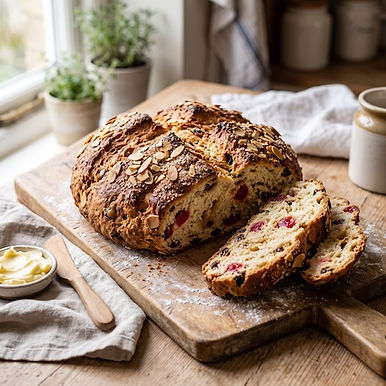
Glacé Cherry & Marzipan Soda Bread
Prep. Time:
Baking Time:
Total Time:
30 mins
40 mins
1 hour 40 mins
Serves:
1 loaf (8–10 slices), plus about 200 g hand-churned butter
Laura created this dish for Great British Bake Off ™ Series 11. The sweet half of her Bread Week Signature pair, this freeform soda bread carries glacé cherries and marzipan grated from frozen, so the almond flavor runs through every slice instead of sitting in dense pockets. Both judges singled out...
Read more
Ingredients
FOR THE SWEET SODA BREAD:
Glacé cherries — 1 cup / 180 g, rinsed, dried thoroughly and quartered Marzipan — 5 oz / 150 g, frozen for 20 minutes, then coarsely grated Plain (all-purpose) flour — 3½ cups / 450 g, plus extra for dusting Bicarbonate of soda (baking soda) — 1 tsp / 5 g, sifted Fine sea salt — 1 tsp / 5 g Caster (superfine) sugar — 3 tbsp / 40 g Unsalted butter — 4 tbsp / 55 g, cold and cubed Buttermilk — 1⅓ cups / 320 ml, cold and well shaken, 2 tbsp held back Buttermilk, extra — 1 tbsp, for brushing Flaked almonds — 2 tbsp / 15 g, for the top Demerara sugar — 1 tbsp / 12 g, for the top
FOR THE HAND-CHURNED HONEY BUTTER:
Double (heavy) cream — 2 cups / 500 ml, at about 68°F / 20°C Iced water — about 2 cups / 500 ml, in changes, for washing Fine sea salt — ½ tsp / 3 g, to taste Runny honey — 1 tbsp / 20 g, optional
EQUIPMENT:
Pizza stone, baking steel or heavy baking sheet, preheated Large mixing bowl Table knife or bench scraper Box grater, coarse side Baking parchment, plus a peel, flat tray or inverted baking sheet Sharp knife or lame Wire cooling rack Instant-read probe thermometer Stand mixer or food processor Muslin and a bowl, for draining and washing the butter
Method
STEP 1: PREHEAT THE OVEN AND BAKING SURFACE
Set the oven to 425°F (220°C / 200°C fan) and put a pizza stone, baking steel or heavy baking sheet on the middle shelf. Give it a full twenty minutes at temperature before the loaf goes in. A preheated mass of stone or steel delivers a burst of base heat that sets the crust immediately and drives the oven spring a soda bread gets in its first ten minutes. This is where the crunch comes from.
STEP 2: PREPARE THE CHERRIES
Tip the glacé cherries into a sieve and rinse under warm water until the syrup has gone, then dry them thoroughly on kitchen paper — genuinely dry, not merely blotted. Quarter them and toss with a tablespoon of the measured flour. Rinsing removes the syrup film that reads as raw and cloying; drying and flouring stop the cherries bleeding color into the crumb or sinking to the base.
STEP 3: GRATE THE MARZIPAN
Put the marzipan in the freezer for twenty minutes, then grate it on the coarse side of a box grater onto a floured plate. Keep it cold and separate until the moment it goes in. Grated shreds disperse through the dough and melt into the crumb as it bakes, seeding almond flavor throughout; diced or rolled marzipan does the opposite, staying as dense, wet pockets while the rest of the loaf tastes only of flour. Use a firm block marzipan with a high almond content, not a marzipan-flavored paste.
STEP 4: MAKE THE DRY MIX AND RUB IN THE BUTTER
Sift the flour and bicarbonate of soda together into a large bowl — an unbroken lump of bicarbonate will bake into a bitter, soapy spot. Stir through the salt and caster sugar. Add the cold cubed butter and rub it in with your fingertips until the mixture looks like coarse breadcrumbs. A little fat is not traditional in a plain soda bread, but it shortens the crumb and suits a sweet, enriched loaf.
STEP 5: COMBINE QUICKLY
Make a well in the center and pour in the buttermilk, holding back the reserved two tablespoons. Using a table knife or bench scraper held upright, cut through the mixture in a rough figure-of-eight until it comes together as a shaggy, distinctly wet dough. Add the reserved buttermilk only if there is dry flour left in the bowl. The acid in the buttermilk and the alkaline bicarbonate begin reacting on contact and the lift they generate is finite, so every extra second and every extra stroke costs rise. Aim to be done in thirty seconds. The dough should look too wet and too rough. That is correct.
STEP 6: FOLD IN THE CHERRIES AND MARZIPAN
Scatter the floured cherries and grated marzipan over the dough and fold just five or six times with the scraper to distribute them. Stop while streaks are still visible. Overmixing at this stage is the commonest way a sweet soda bread turns dense, and it smears the marzipan into paste, undoing step 3.
STEP 7: SHAPE AND SCORE
Turn the dough onto a well-floured sheet of baking parchment. With floured hands, gather it into a rough round about 7 inches (18 cm) across and 2 inches (5 cm) high, pressing only as much as it takes to hold the shape. Do not knead. Cut a deep cross about three-quarters of the way through the loaf. The cross is structural rather than decorative: it opens the dense center to the oven heat and is your main insurance against an underbaked middle.
STEP 8: TOP THE LOAF
Brush the surface lightly with the extra tablespoon of buttermilk, scatter over the flaked almonds and sprinkle with the demerara sugar. The almonds echo the marzipan and toast in the dry heat; the demerara gives an audible crust without sweetening the crumb further.
STEP 9: BAKE IN TWO STAGES
Slide the parchment and loaf directly onto the preheated stone. Bake at 425°F (220°C) for 15 minutes, then drop the oven to 400°F (200°C / 180°C fan) and bake a further 20 to 25 minutes. It is done when it is deep golden, sounds hollow tapped underneath and — the reliable test — reads 205–208°F (96–98°C) at the center on a probe. Take the reading rather than trusting the clock: the sugars brown the crust long before the center is set. If the top darkens too fast, tent it loosely with foil and keep baking.
STEP 10: COOL PROPERLY
Transfer to a wire rack and leave at least 30 minutes before cutting. Soda bread carries on setting as it cools, and cutting it hot gives a gummy, claggy crumb. Cool it uncovered and on a rack — wrapping it warm or leaving it on a solid surface softens the crust you have just worked for.
STEP 11: CHURN THE HONEY BUTTER
Whip the double cream in a stand mixer on medium-high. It will pass through soft peaks, then stiff peaks, then a grainy stage, and at roughly five to eight minutes it will break suddenly into yellow grains and thin buttermilk. Drain through muslin, reserving the buttermilk for another loaf. Now wash the butter: return the grains to the bowl, add a splash of the iced water, work it briefly with a spatula, pour off the cloudy water and repeat until the water runs clear. This is not optional — residual buttermilk is what turns homemade butter rancid within a day or two. Work in the salt, and the honey if using, then roll in parchment and chill.
STEP 12: SERVE
Best on the day it is baked, ideally still faintly warm. Cut in thick wedges following the cross and serve with the butter at room temperature.
What next?
Tell us what you'd like and we'll send what you pick.
Video walkthrough

Simpler recipe version
Printable recipe
Weekly recipe digest
Instructions
FOR THE SWEET SODA BREAD:
Glacé cherries — 1 cup / 180 g, rinsed, dried thoroughly and quartered
Marzipan — 5 oz / 150 g, frozen for 20 minutes, then coarsely grated
Plain (all-purpose) flour — 3½ cups / 450 g, plus extra for dusting
Bicarbonate of soda (baking soda) — 1 tsp / 5 g, sifted
Fine sea salt — 1 tsp / 5 g
Caster (superfine) sugar (/interesting-ingredients/caster-sugar)— 3 tbsp / 40 g
Unsalted butter — 4 tbsp / 55 g, cold and cubed
Buttermilk — 1⅓ cups / 320 ml, cold and well shaken, 2 tbsp held back
Buttermilk, extra — 1 tbsp, for brushing
Flaked almonds (/interesting-ingredients/flaked-almonds)— 2 tbsp / 15 g, for the top
Demerara sugar (/interesting-ingredients/demerara-sugar)— 1 tbsp / 12 g, for the top
FOR THE HAND-CHURNED HONEY BUTTER:
Double (heavy) cream — 2 cups / 500 ml, at about 68°F / 20°C
Iced water — about 2 cups / 500 ml, in changes, for washing
Fine sea salt — ½ tsp / 3 g, to taste
Runny honey — 1 tbsp / 20 g, optional
EQUIPMENT:
Pizza stone, baking steel or heavy baking sheet, preheated
Large mixing bowl
Table knife or bench scraper
Box grater, coarse side
Baking parchment, plus a peel, flat tray or inverted baking sheet
Sharp knife or lame
Wire cooling rack
Instant-read probe thermometer
Stand mixer or food processor
Muslin and a bowl, for draining and washing the butter


Heading 5
Ingredients
STEP 1: PREHEAT THE OVEN AND BAKING SURFACE
Set the oven to 425°F (220°C / 200°C fan) and put a pizza stone, baking steel or heavy baking sheet on the middle shelf. Give it a full twenty minutes at temperature before the loaf goes in. A preheated mass of stone or steel delivers a burst of base heat that sets the crust immediately and drives the oven spring a soda bread gets in its first ten minutes. This is where the crunch comes from.
STEP 2: PREPARE THE CHERRIES
Tip the glacé cherries into a sieve and rinse under warm water until the syrup has gone, then dry them thoroughly on kitchen paper — genuinely dry, not merely blotted. Quarter them and toss with a tablespoon of the measured flour. Rinsing removes the syrup film that reads as raw and cloying; drying and flouring stop the cherries bleeding color into the crumb or sinking to the base.
STEP 3: GRATE THE MARZIPAN
Put the marzipan in the freezer for twenty minutes, then grate it on the coarse side of a box grater onto a floured plate. Keep it cold and separate until the moment it goes in. Grated shreds disperse through the dough and melt into the crumb as it bakes, seeding almond flavor throughout; diced or rolled marzipan does the opposite, staying as dense, wet pockets while the rest of the loaf tastes only of flour. Use a firm block marzipan with a high almond content, not a marzipan-flavored paste.
STEP 4: MAKE THE DRY MIX AND RUB IN THE BUTTER
Sift the flour and bicarbonate of soda together into a large bowl — an unbroken lump of bicarbonate will bake into a bitter, soapy spot. Stir through the salt and caster sugar. Add the cold cubed butter and rub it in with your fingertips until the mixture looks like coarse breadcrumbs. A little fat is not traditional in a plain soda bread, but it shortens the crumb and suits a sweet, enriched loaf.
STEP 5: COMBINE QUICKLY
Make a well in the center and pour in the buttermilk, holding back the reserved two tablespoons. Using a table knife or bench scraper held upright, cut through the mixture in a rough figure-of-eight until it comes together as a shaggy, distinctly wet dough. Add the reserved buttermilk only if there is dry flour left in the bowl. The acid in the buttermilk and the alkaline bicarbonate begin reacting on contact and the lift they generate is finite, so every extra second and every extra stroke costs rise. Aim to be done in thirty seconds. The dough should look too wet and too rough. That is correct.
STEP 6: FOLD IN THE CHERRIES AND MARZIPAN
Scatter the floured cherries and grated marzipan over the dough and fold just five or six times with the scraper to distribute them. Stop while streaks are still visible. Overmixing at this stage is the commonest way a sweet soda bread turns dense, and it smears the marzipan into paste, undoing step 3.
STEP 7: SHAPE AND SCORE
Turn the dough onto a well-floured sheet of baking parchment. With floured hands, gather it into a rough round about 7 inches (18 cm) across and 2 inches (5 cm) high, pressing only as much as it takes to hold the shape. Do not knead. Cut a deep cross about three-quarters of the way through the loaf. The cross is structural rather than decorative: it opens the dense center to the oven heat and is your main insurance against an underbaked middle.
STEP 8: TOP THE LOAF
Brush the surface lightly with the extra tablespoon of buttermilk, scatter over the flaked almonds and sprinkle with the demerara sugar. The almonds echo the marzipan and toast in the dry heat; the demerara gives an audible crust without sweetening the crumb further.
STEP 9: BAKE IN TWO STAGES
Slide the parchment and loaf directly onto the preheated stone. Bake at 425°F (220°C) for 15 minutes, then drop the oven to 400°F (200°C / 180°C fan) and bake a further 20 to 25 minutes. It is done when it is deep golden, sounds hollow tapped underneath and — the reliable test — reads 205–208°F (96–98°C) at the center on a probe. Take the reading rather than trusting the clock: the sugars brown the crust long before the center is set. If the top darkens too fast, tent it loosely with foil and keep baking.
STEP 10: COOL PROPERLY
Transfer to a wire rack and leave at least 30 minutes before cutting. Soda bread carries on setting as it cools, and cutting it hot gives a gummy, claggy crumb. Cool it uncovered and on a rack — wrapping it warm or leaving it on a solid surface softens the crust you have just worked for.
STEP 11: CHURN THE HONEY BUTTER
Whip the double cream in a stand mixer on medium-high. It will pass through soft peaks, then stiff peaks, then a grainy stage, and at roughly five to eight minutes it will break suddenly into yellow grains and thin buttermilk. Drain through muslin, reserving the buttermilk for another loaf. Now wash the butter: return the grains to the bowl, add a splash of the iced water, work it briefly with a spatula, pour off the cloudy water and repeat until the water runs clear. This is not optional — residual buttermilk is what turns homemade butter rancid within a day or two. Work in the salt, and the honey if using, then roll in parchment and chill.
STEP 12: SERVE
Best on the day it is baked, ideally still faintly warm. Cut in thick wedges following the cross and serve with the butter at room temperature.
Comments, or questions, for this recipe
Add a new comment