Recipes, re-invented from cooking shows
Middle Eastern Raised Game Pie

Prep. Time:
Baking Time:
Total Time:
1 hour 15 minutes
2 hours 15 minutes
24 hours (including overnight chill)
Serves:
1 large raised pie (8 in / 20 cm), serves 10–12
Tamal created this dish for Great British Bake Off ™ Series 6. He kept the fixed Victorian raised-pie form and refilled it with an Arabian theme, frying rabbit, pigeon and venison in ras el hanout with extra cinnamon before packing them into a thin hot water crust with dried apricots and toasted alm...
Read more
Ingredients
FOR THE SPICED GAME FILLING: Venison shoulder or haunch – 12 oz (350 g), trimmed and diced 1/2 in (1 cm) Rabbit meat, boned – 9 oz (250 g), leg and saddle, diced 1/2 in (1 cm) Pigeon breasts – 4 breasts (about 200 g), skinned and diced 1/2 in (1 cm) Ras el hanout – 2 tbsp (16 g), aromatic rather than hot Ground cinnamon – 1 1/2 tsp (4 g) Olive oil – 2 tbsp (30 ml), for searing Onion – 1 medium, very finely chopped Garlic cloves – 3, crushed Ground (minced) lamb – 10 oz (300 g), not lean — around 20% fat Dried apricots – 3/4 cup (120 g), soft-dried and roughly chopped Blanched almonds – 1/2 cup (70 g), lightly toasted and roughly chopped Flat-leaf parsley – 3 tbsp, chopped Fine sea salt – 2 tsp (10 g) Black pepper – 1 tsp (2 g), freshly ground
FOR THE HOT WATER CRUST PASTRY: All-purpose (plain) flour – 3 1/2 cups (450 g) Strong white bread flour – 3/4 cup (100 g), for strength in a tall case Fine salt – 1 tsp (5 g) Cold unsalted butter – 5 tbsp (75 g), diced Lard – 1/2 cup (100 g), melted with the water Water – 3/4 cup + 2 tbsp (200 ml), brought to a rolling boil Egg – 1 large, beaten with 1 tsp milk, for glazing
FOR THE SPICED JELLY: Game or chicken stock – 2 cups (500 ml), well flavoured and lightly seasoned Ras el hanout – 1/4 tsp (1 g), to echo the filling Powdered gelatine – 3 tsp (10 g), or 5 sheets leaf gelatine
EQUIPMENT: 8-inch (20 cm) deep springform or loose-bottomed cake tin, or a traditional raised pie mould Heavy saucepan, for the hot water crust Large heavy frying pan or skillet, for searing the spiced game Digital probe thermometer — essential; the pie is judged done by internal temperature Small funnel, or a piping bag fitted with a plain narrow nozzle, for the jelly Baking sheet, to catch any leakage Pastry brush, small sharp knife and rolling pin Small round and leaf cutters, or a knife, for the pastry roses and leaves
Method
STEP 1: SPICE AND SEAR THE GAME
Toss the diced venison, rabbit and pigeon with the ras el hanout and the ground cinnamon until every piece is coated. Heat the olive oil in a large heavy frying pan until shimmering and sear the meat hard in three or four batches — a crowded pan will stew it rather than colour it. You are not cooking it through: 60–90 seconds a batch is enough to colour the surfaces and bloom the spices in the hot fat. This is the step that makes the pie — frying the meat in the spice mix, rather than stirring dry spice into a raw filling, is why the spicing reads as one gentle blend rather than separate powdery notes. Tip each batch into a wide bowl. In the same pan, soften the onion for 6–8 minutes, add the garlic for a final minute, and add both to the meat. Cool completely, ideally in the fridge — warm filling will melt a hot water crust from the inside. Do this the evening before, or at least 2 hours ahead.
STEP 2: BUILD THE FILLING
To the cooled spiced game, add the minced lamb, chopped apricots, toasted almonds, parsley, salt and pepper. Mix thoroughly with your hands until the lamb is evenly distributed through the diced meats — it needs to be in contact with everything, because it is the binder. Fry a teaspoon of the mixture in a small pan and taste it: this is your only chance to adjust the seasoning, and a cold pie needs seasoning a shade more assertively than a hot one. Refrigerate while you make the pastry.
STEP 3: MAKE THE HOT WATER CRUST
Heat the oven to 400°F (200°C) now — hot water crust has to be lined and filled quickly, and waiting on a cold oven is where the case cools and cracks. Grease the tin well and set it beside you. Combine both flours and the fine salt in a large bowl and rub in the cold diced butter with your fingertips until it disappears into the flour. Put the lard and water in a heavy saucepan and bring to a rolling boil, then pour it immediately onto the flour and mix with a wooden spoon until it comes together into a soft, shaggy dough. Turn out and knead briefly until smooth. Work while it is warm — hot water crust is pliable when hot and brittle when cold. Cut off one third for the lid and decoration, wrap it, and keep it somewhere warm.
STEP 4: LINE THE TIN
Roll the larger piece of pastry to a round big enough to line the base and sides with a little overhang, then lift it in, pressing it into the base corner and up the sides. Aim for about 5 mm (1/4 in): Paul Hollywood's instruction for this challenge was to use as little pastry as you can, since crust displaces filling. Thicker than 8 mm and it eats like a pastry problem; thinner than 4 mm and it will split as the filling expands. Patch any thin spots or tears with offcuts, then trim the overhang to about 1 cm (1/2 in) above the rim.
STEP 5: FILL AND LID
Pack the filling into the case in firm layers, pressing down to eliminate air pockets and doming it very slightly in the centre — the filling shrinks as it cooks, and a flat fill leaves a hollow under the lid. Roll the reserved pastry for the lid. Brush the pastry rim with the beaten egg, lay the lid over, press to seal and crimp. Cut a vent hole in the centre about 1 cm (1/2 in) wide and keep it open — you will pour the jelly through it later.
STEP 6: THE ROSES
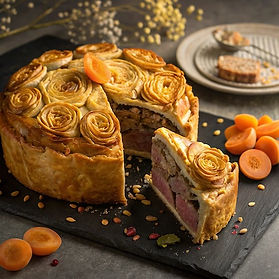
From the remaining pastry, cut small rounds. Overlap five or six of them in a line, roll the line up from one end, and pinch the base to make a rose, then open out the outer petals with a fingertip. Make as many as you like and arrange them around the vent hole with a few cut leaves. Let the decoration pastry cool a little more than the case pastry and prop the outer petals open, or the roses lose definition in the oven. Brush the whole pie generously with egg wash, taking care not to flood the vent.
STEP 7: BAKE
Set the pie on a baking sheet and bake at 400°F (200°C) for 30 minutes, until the pastry is set and starting to colour. Do not shorten this first blast — it is what sets the base. Reduce to 325°F (160°C) and bake for a further 1 hour 45 minutes, brushing with egg wash again at the halfway point for a deep glaze and covering loosely with foil if the roses are browning faster than the sides. The pie is done when a digital probe pushed through the vent into the centre reads 165–170°F (74–77°C); time alone is not a reliable guide here. Cool in the tin for 30 minutes, then release the sides and cool completely at room temperature, about 2 hours.
STEP 8: MAKE AND POUR THE JELLY
Warm the stock with the ras el hanout. Sprinkle the powdered gelatine over 3 tablespoons of cold water, leave it to swell for 5 minutes, then stir it into the hot stock until fully dissolved; if you are using leaf gelatine, soften the sheets in cold water, squeeze them out and stir them in. Cool the liquid to lukewarm. Set the cooled pie on a tray and, using a small funnel or a piping bag with a narrow nozzle in the vent hole, pour the jelly in a little at a time, pausing between additions to let it find its way into the gaps left by the shrinking meat. Stop when it will take no more — you may not need all of it. Chill uncovered for 30 minutes, then top up once more if the level has dropped.
STEP 9: SET, THEN SERVE
Refrigerate the pie for at least 8 hours, preferably overnight. This is the stage the studio clock did not allow: the jelly sets, the filling firms, and the spicing rounds out instead of tasting fragmented. Serve at cool room temperature rather than fridge-cold — take it out 30–45 minutes ahead, since cold mutes the spice blend badly. Cut with a long sharp knife in one firm stroke, wiping the blade between slices. The cut face should be a solid mosaic of dark game, pale lamb and amber apricot, with a clear seam of jelly under the lid.
What next?
Tell us what you'd like and we'll send what you pick.
Video walkthrough

Simpler recipe version
Printable recipe
Weekly recipe digest
Instructions
FOR THE SPICED GAME FILLING:
Venison shoulder or haunch – 12 oz (350 g), trimmed and diced 1/2 in (1 cm)
Rabbit meat, boned – 9 oz (250 g), leg and saddle, diced 1/2 in (1 cm)
Pigeon breasts – 4 breasts (about 200 g), skinned and diced 1/2 in (1 cm)
Ras el hanout – 2 tbsp (16 g), aromatic rather than hot
Ground cinnamon – 1 1/2 tsp (4 g)
Olive oil – 2 tbsp (30 ml), for searing
Onion – 1 medium, very finely chopped
Garlic cloves – 3, crushed
Ground (minced) lamb – 10 oz (300 g), not lean — around 20% fat
Dried apricots – 3/4 cup (120 g), soft-dried and roughly chopped
Blanched almonds – 1/2 cup (70 g), lightly toasted and roughly chopped
Flat-leaf parsley – 3 tbsp, chopped
Fine sea salt – 2 tsp (10 g)
Black pepper – 1 tsp (2 g), freshly ground
FOR THE HOT WATER CRUST PASTRY:
All-purpose (plain) flour – 3 1/2 cups (450 g)
Strong white bread flour – 3/4 cup (100 g), for strength in a tall case
Fine salt – 1 tsp (5 g)
Cold unsalted butter – 5 tbsp (75 g), diced
Lard – 1/2 cup (100 g), melted with the water
Water – 3/4 cup + 2 tbsp (200 ml), brought to a rolling boil
Egg – 1 large, beaten with 1 tsp milk, for glazing
FOR THE SPICED JELLY:
Game or chicken stock – 2 cups (500 ml), well flavoured and lightly seasoned
Ras el hanout – 1/4 tsp (1 g), to echo the filling
Powdered gelatine – 3 tsp (10 g), or 5 sheets leaf gelatine
EQUIPMENT:
8-inch (20 cm) deep springform or loose-bottomed cake tin, or a traditional raised pie mould
Heavy saucepan, for the hot water crust
Large heavy frying pan or skillet, for searing the spiced game
Digital probe thermometer — essential; the pie is judged done by internal temperature
Small funnel, or a piping bag fitted with a plain narrow nozzle, for the jelly
Baking sheet, to catch any leakage
Pastry brush, small sharp knife and rolling pin
Small round and leaf cutters, or a knife, for the pastry roses and leaves



Heading 5
Ingredients
STEP 1: SPICE AND SEAR THE GAME
Toss the diced venison, rabbit and pigeon with the ras el hanout and the ground cinnamon until every piece is coated. Heat the olive oil in a large heavy frying pan until shimmering and sear the meat hard in three or four batches — a crowded pan will stew it rather than colour it. You are not cooking it through: 60–90 seconds a batch is enough to colour the surfaces and bloom the spices in the hot fat. This is the step that makes the pie — frying the meat in the spice mix, rather than stirring dry spice into a raw filling, is why the spicing reads as one gentle blend rather than separate powdery notes. Tip each batch into a wide bowl. In the same pan, soften the onion for 6–8 minutes, add the garlic for a final minute, and add both to the meat. Cool completely, ideally in the fridge — warm filling will melt a hot water crust from the inside. Do this the evening before, or at least 2 hours ahead.
STEP 2: BUILD THE FILLING
To the cooled spiced game, add the minced lamb, chopped apricots, toasted almonds, parsley, salt and pepper. Mix thoroughly with your hands until the lamb is evenly distributed through the diced meats — it needs to be in contact with everything, because it is the binder. Fry a teaspoon of the mixture in a small pan and taste it: this is your only chance to adjust the seasoning, and a cold pie needs seasoning a shade more assertively than a hot one. Refrigerate while you make the pastry.
STEP 3: MAKE THE HOT WATER CRUST
Heat the oven to 400°F (200°C) now — hot water crust has to be lined and filled quickly, and waiting on a cold oven is where the case cools and cracks. Grease the tin well and set it beside you. Combine both flours and the fine salt in a large bowl and rub in the cold diced butter with your fingertips until it disappears into the flour. Put the lard and water in a heavy saucepan and bring to a rolling boil, then pour it immediately onto the flour and mix with a wooden spoon until it comes together into a soft, shaggy dough. Turn out and knead briefly until smooth. Work while it is warm — hot water crust is pliable when hot and brittle when cold. Cut off one third for the lid and decoration, wrap it, and keep it somewhere warm.
STEP 4: LINE THE TIN
Roll the larger piece of pastry to a round big enough to line the base and sides with a little overhang, then lift it in, pressing it into the base corner and up the sides. Aim for about 5 mm (1/4 in): Paul Hollywood's instruction for this challenge was to use as little pastry as you can, since crust displaces filling. Thicker than 8 mm and it eats like a pastry problem; thinner than 4 mm and it will split as the filling expands. Patch any thin spots or tears with offcuts, then trim the overhang to about 1 cm (1/2 in) above the rim.
STEP 5: FILL AND LID
Pack the filling into the case in firm layers, pressing down to eliminate air pockets and doming it very slightly in the centre — the filling shrinks as it cooks, and a flat fill leaves a hollow under the lid. Roll the reserved pastry for the lid. Brush the pastry rim with the beaten egg, lay the lid over, press to seal and crimp. Cut a vent hole in the centre about 1 cm (1/2 in) wide and keep it open — you will pour the jelly through it later.
STEP 6: THE ROSES
From the remaining pastry, cut small rounds. Overlap five or six of them in a line, roll the line up from one end, and pinch the base to make a rose, then open out the outer petals with a fingertip. Make as many as you like and arrange them around the vent hole with a few cut leaves. Let the decoration pastry cool a little more than the case pastry and prop the outer petals open, or the roses lose definition in the oven. Brush the whole pie generously with egg wash, taking care not to flood the vent.
STEP 7: BAKE
Set the pie on a baking sheet and bake at 400°F (200°C) for 30 minutes, until the pastry is set and starting to colour. Do not shorten this first blast — it is what sets the base. Reduce to 325°F (160°C) and bake for a further 1 hour 45 minutes, brushing with egg wash again at the halfway point for a deep glaze and covering loosely with foil if the roses are browning faster than the sides. The pie is done when a digital probe pushed through the vent into the centre reads 165–170°F (74–77°C); time alone is not a reliable guide here. Cool in the tin for 30 minutes, then release the sides and cool completely at room temperature, about 2 hours.
STEP 8: MAKE AND POUR THE JELLY
Warm the stock with the ras el hanout. Sprinkle the powdered gelatine over 3 tablespoons of cold water, leave it to swell for 5 minutes, then stir it into the hot stock until fully dissolved; if you are using leaf gelatine, soften the sheets in cold water, squeeze them out and stir them in. Cool the liquid to lukewarm. Set the cooled pie on a tray and, using a small funnel or a piping bag with a narrow nozzle in the vent hole, pour the jelly in a little at a time, pausing between additions to let it find its way into the gaps left by the shrinking meat. Stop when it will take no more — you may not need all of it. Chill uncovered for 30 minutes, then top up once more if the level has dropped.
STEP 9: SET, THEN SERVE
Refrigerate the pie for at least 8 hours, preferably overnight. This is the stage the studio clock did not allow: the jelly sets, the filling firms, and the spicing rounds out instead of tasting fragmented. Serve at cool room temperature rather than fridge-cold — take it out 30–45 minutes ahead, since cold mutes the spice blend badly. Cut with a long sharp knife in one firm stroke, wiping the blade between slices. The cut face should be a solid mosaic of dark game, pale lamb and amber apricot, with a clear seam of jelly under the lid.
Comments, or questions, for this recipe
Add a new comment