Recipes, re-invented from cooking shows
Buttermilk Panna Cotta

Prep. Time:
Baking Time:
Total Time:
15 minutes
10 minutes
4 hours 25 minutes (minimum; overnight preferred)
Serves:
6 individual panna cottas (about 100 ml each)
Cara created this dish for America's Culinary Cup 1. The silky buttermilk panna cotta was the first of two panna cottas Cara plated in close succession during the Culinary Science & Technology challenge, showcasing gelatin's soft, melt-on-the-tongue set as a counterpoint to her agar-set hibiscus...
Read more
Ingredients
FOR THE BUTTERMILK PANNA COTTA: 1 3/4 tsp (5.5 g) powdered silver-grade gelatin (or 2 1/2 platinum sheets, ~2 g each) 3 tbsp (45 ml) cold water, for blooming gelatin (powdered only) 1 cup (240 ml) heavy cream, not ultra-pasteurised if possible 1/2 cup (120 ml) whole milk 1/3 cup (65 g) granulated sugar 1/2 vanilla pod, split and scraped (or 1 tsp / 5 ml vanilla bean paste) Small pinch (~0.5 g) fine sea salt 1 cup (240 ml) cultured buttermilk, full-fat, well-shaken, cold
TO FINISH & SERVE: Scant neutral oil, for greasing moulds (optional, only if unmoulding) A few flakes of Maldon sea salt, per plate at serving
Method
STEP 1 — BLOOM THE GELATIN Sprinkle the powdered gelatin evenly across the cold water in a small bowl. Do not stir. Let it bloom for 5–10 minutes until fully hydrated - it should look like wet, compact sand. If using sheet gelatin, submerge the sheets in a bowl of cold water for 5–7 minutes, then lift out and squeeze gently to remove excess water before adding in Step 3.
STEP 2 — INFUSE THE CREAM Combine the heavy cream, whole milk, sugar, scraped vanilla seeds and split pod, and the pinch of fine sea salt in a heavy-bottomed saucepan. Warm over medium-low heat, whisking occasionally, until the sugar has fully dissolved and the mixture is steaming but not simmering - approximately 75°C / 165°F. Do not let it boil; boiling weakens gelatin bonds and can denature cream proteins, producing a waxy mouthfeel.
STEP 3 — DISSOLVE THE GELATIN Remove the cream from the heat. Add the bloomed gelatin all at once and whisk gently but continuously for 30–45 seconds, scraping the base of the pan, until the gelatin is completely dissolved. There must be no grit or transparent flecks visible - undissolved gelatin will set apart as a blob in the finished panna cotta.
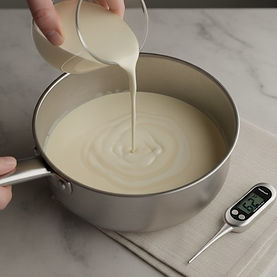
STEP 4 — ADD THE BUTTERMILK Retrieve and discard the vanilla pod. Let the cream base cool for about 3 minutes, down to 60–65°C (140–150°F) - warm but not hot. Pour in the cold buttermilk in a slow stream while whisking constantly. Too hot and the acid will split the cream into granular curds; too cool (below 40°C) and the mixture will begin to set unevenly in the pan. This is the single most important step in a buttermilk panna cotta.
STEP 5 — STRAIN AND PORTION Strain the mixture through a fine-mesh sieve into a pouring jug. This catches any last fragments of vanilla pod and traces of undissolved gelatin, ensuring a smooth texture. Divide evenly among 6 moulds (about 140 ml / 4.7 fl oz per mould, or to within 3 mm of the rim). Tap each mould gently on the counter to release air bubbles, which would otherwise appear as dimples on the surface.
STEP 6 — CHILL UNTIL SET Cover each mould with cling film placed directly on the liquid surface to prevent a skin forming. Refrigerate for at least 4 hours - overnight is better, and flavour is most expressive after 12–18 hours, when the buttermilk tang re-asserts itself over the sugar. If unmoulding, lightly grease the moulds with a whisper of neutral oil before pouring in Step 5.
STEP 7 — UNMOULD AND PLATE To unmould, run a thin paring knife around the inside rim, dip the base of the mould into warm (not hot) water for 3–5 seconds, and invert onto a chilled plate with a single firm downward shake. It should settle with a soft quiver. Sprinkle a few flakes of sea salt at the base at the moment of serving - the salt is what separates a buttermilk panna cotta from a plain vanilla one.
TROUBLESHOOTING: Mixture split or grainy in the pan - buttermilk added to base that was still too hot; cool base to 60–65°C before adding. Grainy or rubbery set - gelatin not fully dissolved, or mixture boiled after gelatin added; dissolve gelatin off the heat, never boil afterwards. Won't release from mould - under-dosed gelatin, mould not greased, or water dip too brief; dip for 3–5 seconds in warm (not hot) water. Holds a sharp edge when cut - gelatin over-dosed; reduce by 0.5–1 g next time. Skin on surface - cling film was not in direct contact with liquid; press it to the surface.
What next?
Tell us what you'd like and we'll send what you pick.
Video walkthrough

Simpler recipe version
Printable recipe
Weekly recipe digest
Instructions
STEP 1 — BLOOM THE GELATIN
Sprinkle the powdered gelatin evenly across the cold water in a small bowl. Do not stir. Let it bloom for 5–10 minutes until fully hydrated - it should look like wet, compact sand. If using sheet gelatin, submerge the sheets in a bowl of cold water for 5–7 minutes, then lift out and squeeze gently to remove excess water before adding in Step 3.
STEP 2 — INFUSE THE CREAM
Combine the heavy cream, whole milk, sugar, scraped vanilla seeds and split pod, and the pinch of fine sea salt in a heavy-bottomed saucepan. Warm over medium-low heat, whisking occasionally, until the sugar has fully dissolved and the mixture is steaming but not simmering - approximately 75°C / 165°F. Do not let it boil; boiling weakens gelatin bonds and can denature cream proteins, producing a waxy mouthfeel.
STEP 3 — DISSOLVE THE GELATIN
Remove the cream from the heat. Add the bloomed gelatin all at once and whisk gently but continuously for 30–45 seconds, scraping the base of the pan, until the gelatin is completely dissolved. There must be no grit or transparent flecks visible - undissolved gelatin will set apart as a blob in the finished panna cotta.
STEP 4 — ADD THE BUTTERMILK
Retrieve and discard the vanilla pod. Let the cream base cool for about 3 minutes, down to 60–65°C (140–150°F) - warm but not hot. Pour in the cold buttermilk in a slow stream while whisking constantly. Too hot and the acid will split the cream into granular curds; too cool (below 40°C) and the mixture will begin to set unevenly in the pan. This is the single most important step in a buttermilk panna cotta.
STEP 5 — STRAIN AND PORTION
Strain the mixture through a fine-mesh sieve into a pouring jug. This catches any last fragments of vanilla pod and traces of undissolved gelatin, ensuring a smooth texture. Divide evenly among 6 moulds (about 140 ml / 4.7 fl oz per mould, or to within 3 mm of the rim). Tap each mould gently on the counter to release air bubbles, which would otherwise appear as dimples on the surface.
STEP 6 — CHILL UNTIL SET
Cover each mould with cling film placed directly on the liquid surface to prevent a skin forming. Refrigerate for at least 4 hours - overnight is better, and flavour is most expressive after 12–18 hours, when the buttermilk tang re-asserts itself over the sugar. If unmoulding, lightly grease the moulds with a whisper of neutral oil before pouring in Step 5.
STEP 7 — UNMOULD AND PLATE
To unmould, run a thin paring knife around the inside rim, dip the base of the mould into warm (not hot) water for 3–5 seconds, and invert onto a chilled plate with a single firm downward shake. It should settle with a soft quiver. Sprinkle a few flakes of sea salt at the base at the moment of serving - the salt is what separates a buttermilk panna cotta from a plain vanilla one.
TROUBLESHOOTING:
Mixture split or grainy in the pan - buttermilk added to base that was still too hot; cool base to 60–65°C before adding.
Grainy or rubbery set - gelatin not fully dissolved, or mixture boiled after gelatin added; dissolve gelatin off the heat, never boil afterwards.
Won't release from mould - under-dosed gelatin, mould not greased, or water dip too brief; dip for 3–5 seconds in warm (not hot) water.
Holds a sharp edge when cut - gelatin over-dosed; reduce by 0.5–1 g next time.
Skin on surface - cling film was not in direct contact with liquid; press it to the surface.


Heading 5
Ingredients
FOR THE BUTTERMILK PANNA COTTA:
1 3/4 tsp (5.5 g) powdered silver-grade gelatin (or 2 1/2 platinum sheets, ~2 g each)
3 tbsp (45 ml) cold water, for blooming gelatin (powdered only)
1 cup (240 ml) heavy cream, not ultra-pasteurised if possible
1/2 cup (120 ml) whole milk
1/3 cup (65 g) granulated sugar
1/2 vanilla pod, split and scraped (or 1 tsp / 5 ml vanilla bean paste)
Small pinch (~0.5 g) fine sea salt
1 cup (240 ml) cultured buttermilk, full-fat, well-shaken, cold
TO FINISH & SERVE:
Scant neutral oil, for greasing moulds (optional, only if unmoulding)
A few flakes of Maldon sea salt, per plate at serving
Comments, or questions, for this recipe
Add a new comment